STUDY FINDS HALYARD* FLUIDSHIELD*3 N95 RESPIRATORS ACHIEVE A 98.2% QUANTITATIVE FIT TEST PASS RATE
Executive Summary
Proper N95 respirator fit is critical to protecting healthcare workers; even small gaps can render the respirator ineffective. But fit varies widely based on the wearer’s facial structure, gender, and facial hair, making it challenging for healthcare facilities to find an N95 respirator that is effective across their entire workforce.
With its commitment to evidence-based design, Owens & Minor (O&M) engaged third-party laboratory, Anthrotech, Inc., to conduct a fit test of its HALYARD* FLUIDSHIELD* 3 N95 Respirators (in sizes small and regular) using NIOSH’s bivariate
panel and the OSHA-approved TSI PortaCount 8048 respirator fit tester.1
The Results
98.2% of study participants (56 out of 57) passed the quantitative fit test (QFT) in one or more sizes of the O&M N95 respirators.
Study Summary and Results
- Product: HALYARD* FLUIDSHIELD*3 N95 Respirators (46727 and 46827) in sizes small and regular
- Objectives: Fit test to verify NIOSH pass/fail and determine fit performance
- Participants: 57 participants experienced in wearing N95 respirators, 75% required to wear a respirator for their job; healthcare professionals were the top priority
- Results: 98.2% (56 out of 57) quantitative fit test pass rate
Key Takeaways for Health Systems
The 98.2% QFT pass rate for the HALYARD* N95 Respirators is significantly higher than the previously documented 22% pass rate.2
Notably, over half of the participants in the HALYARD* Respirator study were female. Yet the high pass rate was consistent across gender, standing in contrast to prior research where women were 58% more likely to fail the QFT in the regular size respirator and 78% more likely to fail in the small size respirator.2
These findings support how the HALYARD* N95 Respirators in sizes small and regular fit the majority of the North American population, providing health systems with greater flexibility in sourcing and inventory management— especially valuable during supply chain constraints or surge demand.
Introduction: Why N95 Fit Matters
N95 respirators are critical in healthcare and industrial settings, but fit inconsistencies remain a challenge.3 To be effective, N95 respirators must form a secure seal to provide full protection.4
As a multi-national group of researchers from the U.S., UK, and China noted in their peer-reviewed journal article:
“Better-fitting masks offer fewer gaps between the wearer’s face and the edges of the mask, ensuring that inhaled air is filtered. Air tends to take the path of least resistance; therefore, if there are small gaps around a high resistance mask, air will tend to travel through them, thus bypassing filtration of the mask material.”5
“Fit is a primary factor in determining the effectiveness of respirators such as N95 masks, and that inadequate fit can negate the potential benefit of wearing respiratory protection.”
– Disaster Medicine and Public Health Preparedness4
A Healthcare Organization’s Duty to Its Workers
U.S. health systems, hospitals, and other patient care sites are responsible for providing their healthcare workers with personal protective equipment (PPE) to minimize the transmission of infectious diseases.
Under the Occupational Safety and Health Administration’s (OSHA) federal Respiratory Protection standard, healthcare organizations must not only equip their employees at risk for airborne pathogen exposure with N95 respirators but also perform annual fit testing.6
As the National Institute for Occupational Safety and Health (NIOSH) states on its website, “Fit testing is important to ensure the expected level of protection is provided by minimizing the total amount of contaminants that leak into the facepiece through the face seal.”7
N95 Fit Challenges
Research has found that healthcare organizations are challenged with standardizing N95 respirators across a workforce with diverse face sizes:
“The fit of N95 for wearers depends on their facial features. Medical staff should fully consider their facial dimensions when choosing an appropriate N95 to improve the protective efficacy of respirators and to reduce the risk of infection by respiratory diseases.”8
Facial hair is another factor that impacts fit. The BEARDS (BEnchmarking Adequate Respiratory DefenceS) study found adequate respirator fit decreased significantly with increasing facial hair, with the authors noting how their findings support quantitative fit testing prior to respirator use.9
In a study of 8,809 healthcare workers, the overall respirator fit test pass rate was <75%, with women having a 44% higher likelihood of failure.
– American Journal of Infection Control3
As part of its Respiratory Protection Standard, OSHA has published a “Facial Hairstyles and Filtering Facepiece Respirators” diagram, which is intended for workers who wear tight-fitting respirators.10
Beard bands have been shown to help improve respirator fit for those with facial hair.11 In 2024, NIOSH launched a project, “Fit Testing of Respirators on Those Wearing Beard Bands’’ to determine how well respirators provide protection to workers with facial hair when using a beard band.12
Additionally, gender has been shown to influence N95 fit outcomes. In a University of Florida College of Medicine study involving 8,809 healthcare workers, the overall fit test failure rate was 15.2%, with women 44% more likely to fail than men.3
Risks of Poor N95 Fit
When an N95 respirator lacks an effective seal on the wearer’s face, the leaks can have significant effects.4
Researchers from the University of Cambridge in the UK and Northwestern University in Chicago discovered that “gaps of diameters of 1.4 mm or larger will compromise the fit of N95 respirators in many wearers, while gaps larger than 2 mm diameter will compromise fit in all or almost all wearers.”4
“As users cannot reliably detect leakage, it is of critical importance that the design and use of the mask be such as to ensure fit and protection.”
– Disaster Medicine and Public Health Preparedness4
A retrospective case-control study on the effectiveness of N95 respirator fit testing for the prevention of severe acute respiratory syndrome (Coronavirus 2), published in the January 2025 edition of the journal Cureus, found higher SARS-CoV-2 infection rates among hospital employees who failed the N95 respirator fit test.13
FIT TEST STUDY OF HALYARD* FLUIDSHIELD* 3 N95 RESPIRATORS
In August 2024, O&M engaged Anthrotech, Inc. to conduct a fit study of HALYARD* FLUIDSHIELD* 3 N95 Respirators
(46727 and 46827 NIOSH TC-84A-7521).
By engaging an independent testing group and using OSHA-approved methodologies, O&M ensured objectivity and credibility in its evaluation. Conducted on a North American population, the study aimed to assess whether both the regular and small sizes of HALYARD* N95 Respirators conform well across a diverse set of face types.
Objective
• To verify NIOSH pass/fail fit test results for HALYARD* N95 Respirators in sizes small and regular
Participants
- 57 participants who are experienced in wearing N95 respirators
– Participants were recruited to represent diverse racial and ethnic backgrounds, as well as individuals who wear eyeglasses - 75% were required to wear a respirator for their job
- 30 of the 57 participants were female (52.6%), fulfilling the NIOSH bivariate panel minimum participant number requirement for each gender
- Healthcare professionals were the top priority
Methodology
The study used the following equipment and methodology:
- An OSHA-approved TSI PortaCount 8048 respirator fit tester featuring FitPro Ultra™ Fit Test Software to automate training, testing, and recordkeeping
- An N-95 companion
- A PortaCount pass (≥100) in any
- of the fit tests would count as a pass for the NIOSH panel assessment
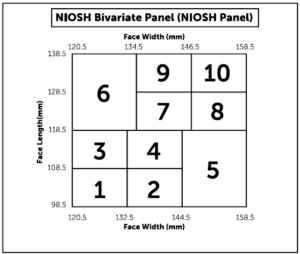
- NIOSH’s 10-cell bivariate panel
Demographics and measurements related to face anthropometry of the study participants were also collected:
- Manual measurement of participant faces using spreading calipers, sliding calipers, tape measure, and Pupilometer
- Anatomical landmarks were placed on their faces using a surgical marker, which were used to take anthropometric measurements
- Scanning of participants with an Artec Leo 3d scanner
- Measurements were taken from each participant’s head to various reference points on the respirator while it was worn
The NIOSH Bivariate Fit Test Panel is divided into 10 cells, each corresponding to a unique combination of face length and width. Cells 1–3 represent smaller face sizes, cells 4–7 represent medium sizes, and cells 8–10 represent larger sizes. A person’s assigned cell is determined by measuring their face length (Menton-Sellion measurement) and face width (Bizygomatic Breadth measurement) using digital calipers.14
Fit Testing
Participants were randomly assigned HALYARD* N95 Respirators in both available sizes—small and regular. Each respirator was worn for at least five minutes before testing, during which time participants completed a fit questionnaire to capture perceptions of tightness, comfort, and any interference.
Fit testing was then performed using the OSHA-approved PortaCount® method. If a participant passed (score ≥100), a second test was administered for confirmation. If the first attempt failed, the respirator was readjusted and retested. Regardless of outcome, participants proceeded to test the alternate respirator size under the same conditions.
Finally, based on PortaCount scores and questionnaire feedback, each participant was assigned a best-fit size. This multi-step approach ensured that both objective measurements and wearer-reported experience were used to determine the most suitable respirator fit.
Data Analysis and Quality Assurance
Fit test data and PortaCount results were compiled into a single spreadsheet and prepared for analysis in Microsoft Excel and SPSS™. Individual PortaCount reports were saved, with the dataset cleaned for missing values and checked for outliers.
A Wilcoxon Signed-Rank test was then applied to determine whether differences in performance existed between manufacturers for the size-of-best-fit respirator.
Respirator Quality Assurance (QA)
The study team incorporated quality assurance measures to ensure accurate results. Respirators were measured to confirm compliance with manufacturer specifications, and any observed variations during testing were documented. These observations were then compared with PortaCount fit scores to determine whether quality issues influenced outcomes. Data analysis and validation steps further reinforced the reliability of the findings.
Results
- 98.2% (56* out of 57) participants passed the fit test in one or more sizes of the HALYARD* FLUIDSHIELD* 3 N95 Respirators
- The majority of participants (88%) were best suited to the regular size
- 11 participants could fit into either size successfully, showing flexibility in respirator design
One participant, with very low BMI and hollow cheeks, was the only failure—highlighting potential challenges in low body fat populations.
An anecdotal observation during testing noted slight asymmetrical fogging on glasses when the nose piece was positioned off-center. While this did not significantly affect PortaCount scores, it underscores the importance of properly adjusting the nose wire to ensure optimal fit and comfort.
Conclusion
With a 98.2% NIOSH pass rate, this study affirms that HALYARD* FLUIDSHIELD* 3 N95 Respirators deliver a consistently high level of fit and protection for healthcare professionals. But it also reflects something larger: O&M’s unwavering dedication to clinician safety and product quality. Through independent validation, ongoing research, and a commitment to evidence-based design, O&M is ensuring its products evolve alongside the needs of healthcare workers.
Just as important, this was not a one-time initiative. O&M is making sustained investments in real-world testing, building a foundation for continuous improvement and innovation across its respiratory protection portfolio. By listening to the challenges clinicians face with fit testing and aligning product development with evidence-based insights, O&M is not only validating today’s designs but also shaping the next generation of respirators.
1. N95 Respirator Face Mask Fit Test Report, Owens & Minor, August 20, 2024
2. Zhang M (Meilun), Hackett L, Smith J, et al. Striving to be the fittest: quantitative P2/N95 respirator fit test results among hospital staff during the COVID-19 pandemic. Antimicrobial Stewardship & Healthcare Epidemiology. 2023;3(1):e233. doi:10.1017/ash.2023.503
3. Wardhan R, Patel V, Neff AB, Cook RB, White JD, Vasilopoulos T. Qualitative fit test outcomes for N95 filtering facepiece respirators in health care workers. Am J Infect Control. 2023 Feb;51(2):194-198. doi: 10.1016/j.ajic.2022.05.022. Epub 2022 Jun 1. PMID: 35659562
4. O’Kelly E, Arora A, Pirog S, Ward J, Clarkson PJ. Experimental Measurement of the Size of Gaps Required to Compromise Fit of an N95 Respirator. Disaster Med Public Health Prep. 2022 Jan 21;17:e118. doi: 10.1017/dmp.2022.23. PMID: 35057880; PMCID: PMC8961060
5. O’Kelly E, Arora A, Pirog S, Pearson C, Ward J, Clarkson PJ. Face mask fit hacks: Improving the fit of KN95 masks and surgical masks with fit alteration techniques. PLoS One. 2022 Feb 2;17(2):e0262830. doi: 10.1371/journal.pone.0262830. PMID: 35108287; PMCID: PMC8809580
6. Healthcare Respiratory Protection, National Institute for Occupational Safety and Health (NIOSH), January 15, 2025, https://www.cdc.gov/niosh/healthcare/respiratory-protection/index.html
7. Fit Testing, National Institute for Occupational Safety and Health (NIOSH), February 3, 2025, https://www.cdc.gov/niosh/ppe/respirators/fit-testing.html
8. Wang G, Luo C, Cui C, Huang J. Study on the relationship between the fitness of three types of N95 respirators and facial dimensions. J Occup Environ Hyg. 2024 May;21(5):319-325. doi: 10.1080/15459624.2024.2311295. Epub 2024 Feb 28. PMID: 38416473.
9. Sandaradura I, Goeman E, Pontivivo G, Fine E, Gray H, Kerr S, Marriott D, Harkness J, Andresen D. A close shave? Performance of P2/N95 respirators in healthcare workers with facial hair: results of the BEARDS (BEnchmarking Adequate Respiratory DefenceS) study. J Hosp Infect. 2020 Apr;104(4):529-533. doi: 10.1016/j.jhin.2020.01.006. Epub 2020 Jan
21. PMID: 31978416.
10. Facial Hairstyles and Filtering Facepiece Respirators, OSHA, https://www.cdc.gov/niosh/media/pdfs/2024/12/NPPTL_INFO_FacialHairstylesandFFRs_2017.pdf
11. Williams DL, Kave B, Bodas C, Begg F, Roberts M, Ng I. Prospective comprehensive evaluation of an elastic-band beard cover for filtering facepiece respirators in healthcare workers. Infect Control Hosp Epidemiol. 2024 Jan;45(1):89-95. doi: 10.1017/ice.2023.141. Epub 2023 Jul 12. PMID: 37435792; PMCID: PMC10782203.
12. Partnership Opportunity To Determine the Fit of Air Purifying Filtering Facepiece Respirators Worn Over Beard Bands for Workers With Facial Hair, Federal Register, July 25, 2024, https://www.govinfo.gov/content/pkg/FR-2024-07-25/pdf/2024-16351.pdf
13. Fujimoto G, Obikane S, Kuboyama K. Effectiveness of N95 Mask Fit Testing for the Prevention of Severe Acute Respiratory Syndrome Coronavirus 2: A Retrospective Case-Control Study. Cureus. 2025 Jan 8;17(1):e77168. doi: 10.7759/cureus.77168. PMID: 39925504; PMCID: PMC11806276.
14. Respirator Fit Test Panels, https://www.med.navy.mil/Portals/62/Documents/NMFA/NMCPHC/root/Industrial%20Hygiene/RESPIRATOR-FIT-TEST-PANELS.pdf?
ver=MagTQ0twWrj-QQLn-4VhwQ%3D%3D